
Omaha City Directory Holdings
The Omaha Public Library city-directory collection reports Omaha print volumes from 1866 to the present, alongside other Nebraska and metro runs. It is the clearest local starting point because the collection identifies the place and format rather than treating every old name as a current record. The earliest inspected title is Collins' 1866 volume. Later publisher and imprint details should be taken from the catalog record or the title page for the particular volume, because the public collection page does not provide a complete publisher-by-year list.
| Collection | Years | Where Held | Access |
|---|---|---|---|
| Omaha print city directories | 1866-current | Omaha Public Library | Omaha collection access; confirm the needed volume |
| Collins' Omaha City Directory | 1866 | Google Books, digitized from Princeton | Online Omaha title and scan access |
| Omaha historical-directory microfilm | 1866-1979 on the microfilm page | Omaha Public Library | Omaha microfilm access; ask staff for reel details |
| Douglas County archival records, RG0230 | 1855-2000 | Nebraska State Historical Society | Request Omaha or Douglas County material by collection, reel, or date range |
Collection coverage is a finding aid, not a promise that every year has the same sections or image access. For Omaha research, begin with the place as printed. A listing under Omaha, South Omaha, Benson, or Dundee should retain that published label because those historical labels do not always line up with today's boundaries.
See the digitized Collins' Omaha City Directory before requesting the earliest volume.
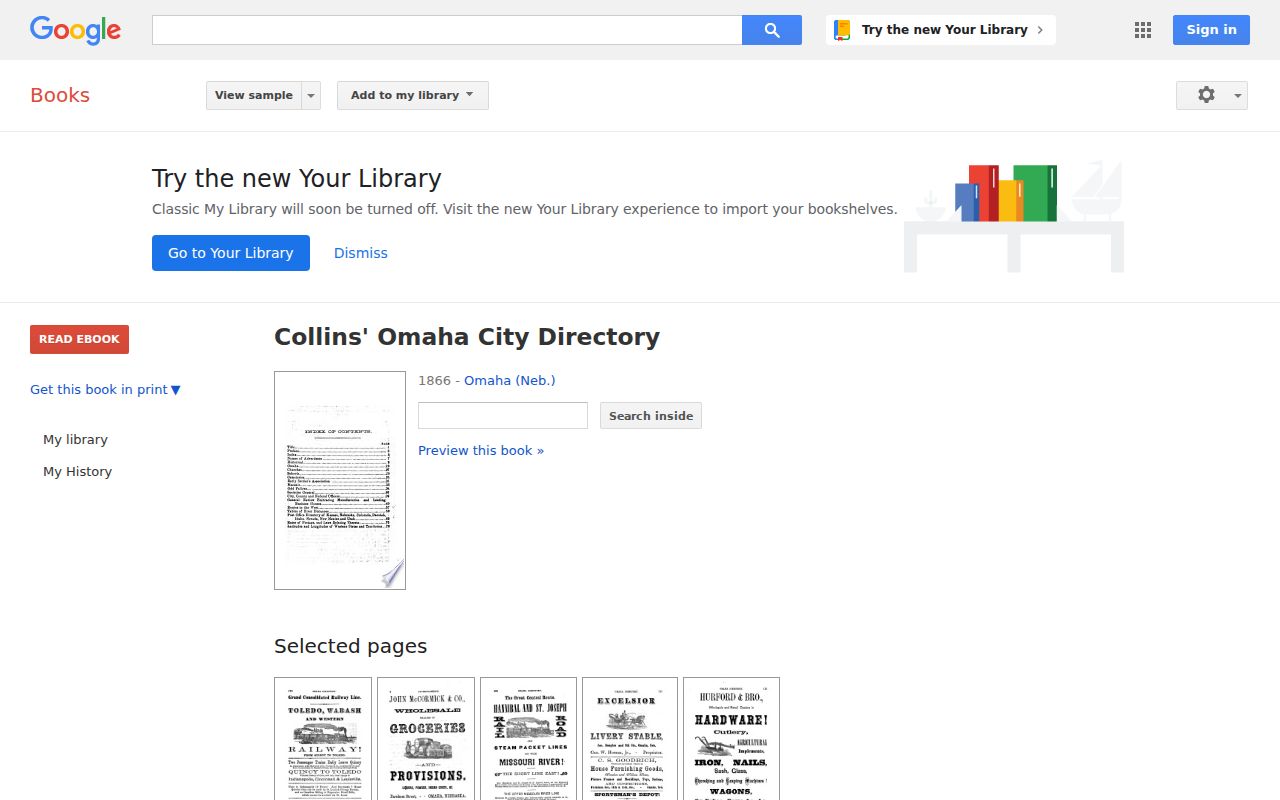
The title scan is a useful way to confirm the 1866 Omaha publication and its period terminology before transcribing a name or address.
Omaha City Directory Begins
Collins' Omaha City Directory is the earliest inspected Omaha title, dated 1866. Its title and contents include local institutional material as well as the directory. The scan shows familiar period abbreviations: res for residence, bds for boards, and cor for corner. Preserve the spelling, punctuation, capitalization, and abbreviation from the Omaha page before adding a modern reading in notes. A period abbreviation can matter when two similar names appear near one another.
A full interior name entry from the Collins volume was not inspected in the research run. That makes the Omaha schema below a careful reading aid, not a claim that every field appears in every entry. It is safer to distinguish a business location from a residence, and to record a cross-reference only when it is visible in that specific volume. The Library of Congress directory guide likewise notes that coverage and fields varied with the publisher and its canvass.
Omaha Directory Format Gap
The Omaha library's two directory descriptions do not state the same microfilm end point. Its historical microfilm page lists Omaha directories from 1866 through 1979, while a collection description discusses microfilm through 2001. That difference may reflect catalog wording, format, or a changed run. It should not be flattened into one certain date. Give the Genealogy & Local History Room the Omaha year and place you need, then ask staff to confirm the exact print volume or reel.
FamilySearch catalog runs were found as a discovery clue for several Omaha and South Omaha periods, but their exact catalog pages and image availability were not confirmed in the official sources inspected. Treat an Omaha catalog hit as a lead. Do not promise an online scan until its catalog entry and access conditions have been checked. This approach also avoids mistaking a catalog description for the pages themselves.
- 1866: Collins' Omaha City Directory is the earliest inspected digitized title.
- 1866-current: OPL reports the Omaha print-directory run.
- 1866-1979: OPL's historical microfilm page states this Omaha directory range.
- Through 2001: another collection description discusses microfilm coverage, so staff confirmation remains necessary for a requested Omaha volume.
Note: Record the Omaha repository, format, volume or reel, and publication year whenever a directory item is used.
Omaha Directory Research Desk
The Genealogy & Local History Room at Omaha Public Library is at Central Library, 7205 Dodge Street, Omaha, Nebraska 68114, and lists 402-444-4800. Its local materials include government documents, local history, newspapers and census material. The microfilm room adds more than 7,000 census reels and four scanners for saving work to a flash drive. That makes the library a practical place for Omaha researchers to compare a directory lead with nearby-year census, newspaper, probate, church, cemetery, or naturalization material.
See the Omaha Public Library genealogy room before planning an in-person Omaha directory search.
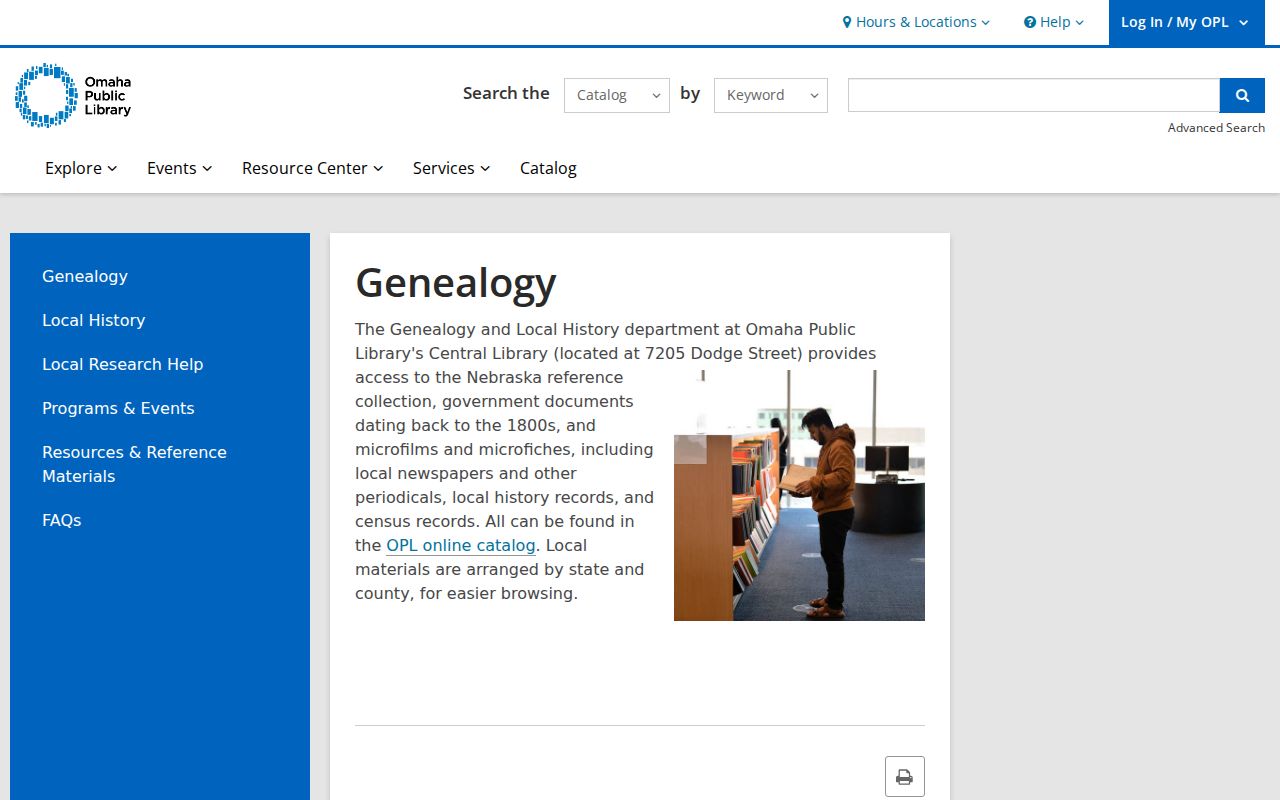
The Omaha library collection brings the relevant formats together, which helps when an alphabetical listing does not answer the household question by itself.
The city-directory collection page is the best volume-level starting point for an Omaha title.
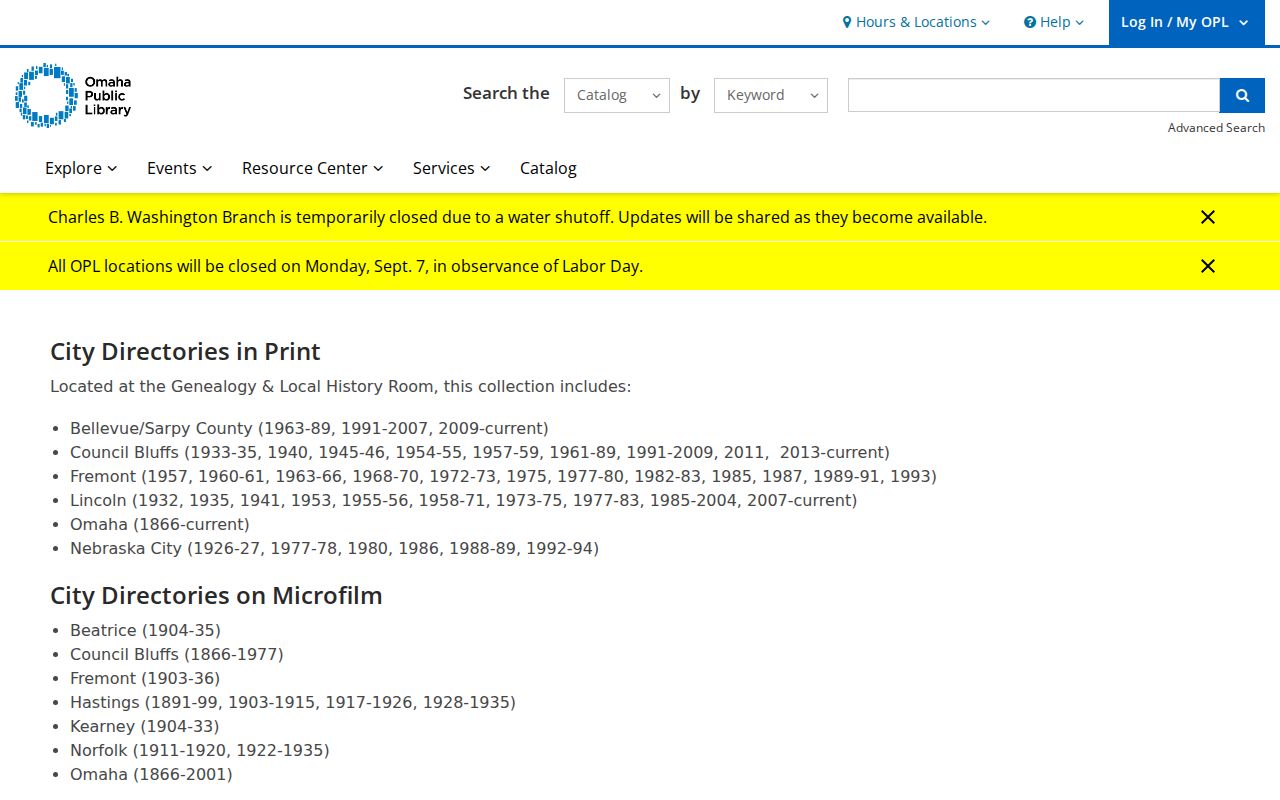
Use the collection listing to narrow the requested Omaha year, then verify the title page and the entry's own editorial conventions.
For a limited remote check, OPL research help will search Omaha city directories, obituary card indexes, and book indexes for up to three names or items. Standard copy research is $5 per copy in advance. A more extensive search can run up to half an hour for $20 in advance, including five copies, with extra pages at $1. Mail, email, and the research-request form are documented routes. Include Omaha dates, locations, and a self-addressed stamped envelope for a mailed request.
Reading Omaha City Directory Entries
Read an Omaha entry as a publication-year clue. Start with the surname, given name, or initial exactly as printed. Then separate the residence from any occupation or business wording. Household status can appear as boards, widow or widower notation, spouse or family context, or a separate entry. A classified or business section may add a cross-reference, but it does not automatically identify the same Omaha address as a residence. The exact arrangement varies by volume.
| Name as printed | Preserve surname, given name, initial, spelling, and capitalization. |
|---|---|
| Residence or address | Copy the Omaha street number, street name, location phrase, and any res or cor wording. |
| Household status | Note boards, widow or widower language, spouse context, or separate household entries only if shown. |
| Occupation or business | Keep a business address separate from a residence and follow the actual section reference. |
| Editorial key | Use the abbreviation key and same-address convention from that individual directory. |
- Criss-cross directory
- An Omaha address-ordered section, when a volume includes one, used to approach a historical location rather than a surname.
- Householder index
- A directory arrangement that points to a household or address; its scope must be checked in the volume.
- Abbreviation key
- The volume's explanation of shortened terms and conventions. It is the first reference point for a faithful transcription.
Omaha Directory City Labels
Omaha historic geography can change the search terms. An address or person may be printed under Omaha, South Omaha, Benson, Dundee, a township, or a rural-route label even where a modern map returns Omaha. Search the original label first, then test the modern Omaha form as a separate lookup. Do not silently replace the historic location in a transcription. A label describes how that publisher organized its material at that point in time.
When an old Omaha street address will not connect to a modern parcel, use a near-date map or plat as context and mark the connection as uncertain until an original source supports it. For modern address-keyed records, the Omaha street directory route uses parcel and GIS tools rather than rebuilding the historical shelf.
Note: A directory listing is not proof of current address, ownership, voter status, or legal service.
Omaha City Directory Family Trail
An Omaha household trail works best when each listing stays tied to its publication year. Start with an exact name and a known year or address. Check the alphabetical section, then the classified or business section if the entry points there. Compare the prior and following Omaha volume so that a move, changed initials, or vanished listing has a date range rather than a guessed explanation. A disappearance can mean a move, death, a changed listing practice, or simple omission. It does not decide which one alone.
- Find the person in a dated Omaha directory and copy the name, address, and all visible abbreviations.
- Check the preceding and following Omaha directory years, keeping each address in its own dated note.
- For a 1910-era Omaha directory, compare the household with the 1910 federal census; make the same year-to-year pairing for 1920, 1930, 1940, or 1950 when the dates fit.
- Use an address-ordered section only when the volume supplies one, then record nearby names as separate leads rather than assumed relatives.
- Test a later endpoint with an obituary index, cemetery record, probate material, or newspaper source that identifies its own date and role.
The Omaha library's microfilm holdings include more than directories. They also include local cemetery, church, naturalization, probate, birth, and death material, which can resolve a dated household clue without turning it into a broad personal profile.
Omaha City Directory Microfilm
The Omaha and Nebraska historical microfilm collection links Omaha directory work to Douglas County records such as cemetery, church, naturalization, and probate material. Ask for the exact Omaha title, date, and format instead of only a surname. For an archival request beyond the library, the Douglas County RG0230 finding aid spans 1855-2000 and describes about 1,780 reels, 72 boxes, 90 cubic feet, and 224 volumes. An Omaha request needs a collection or record group, a reel or series if known, and a date range.
Review the OPL historical microfilm holdings when the Omaha directory alone does not settle a household question.
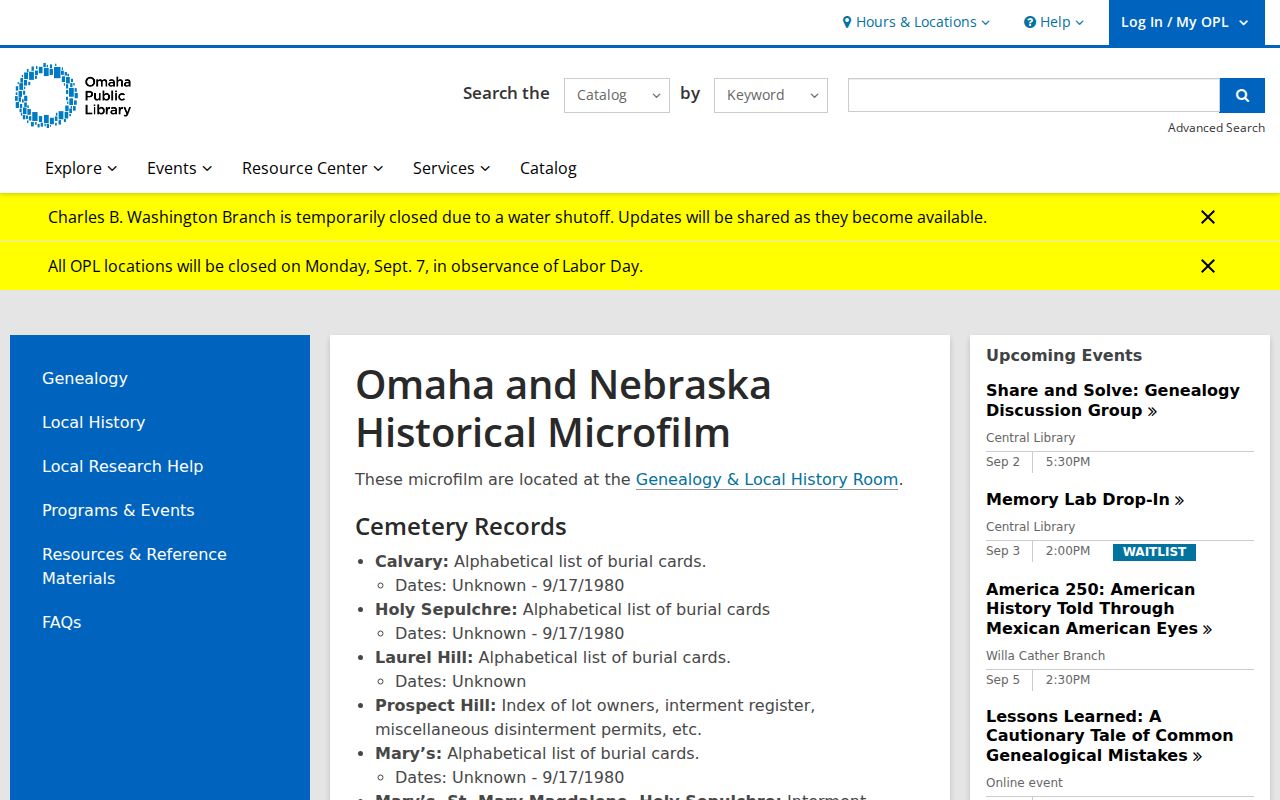
Omaha microfilm offers a second research path when a print run, digitized scan, or index does not contain the needed year.
Omaha Directory Claims Need Context
Omaha historical directories may mix a useful listing with promotional copy. A Nebraska State Historical Society account of an 1888 directory contrasts that Omaha volume's claimed population of 125,000 with an 1880 census count near 30,000. The contrast is a warning, not a population estimate to repeat without context. A directory's promotional total and a census count come from different methods and answer different questions.
Use an Omaha city-directory result to locate the next source, preserve its date and wording, and state what it can actually show. That restraint keeps an Omaha historical directory useful for family history while respecting the limits of the evidence.