
Finding Omaha Residents by Record
Omaha records work best when the search starts with a specific purpose. The Douglas County assessor and DOGIS help connect an Omaha address to an Omaha parcel. LandmarkWeb then identifies recorded Omaha parties and book or image references. The election commission can return voting information for a known Omaha address, while the library can place a person at an old Omaha address in a particular publication year. None of those sources is a complete current household list. Read the named role and date before treating a result as an Omaha lead.
A good Omaha residents directory search also keeps the original address spelling. South Omaha, Benson, Dundee, and a modern Omaha mailing address can point to different Omaha labels in older records. Preserve the raw Omaha address, source year, office, and result type. That makes it possible to compare two Omaha records without silently turning a recorded owner or an old directory listing into a claim about a current occupant.
- For an Omaha address, start with the assessor or DOGIS parcel view and save the parcel, addition, lot, block, and city-limit context shown.
- Use the party names or legal description in Douglas County LandmarkWeb to find the recorded instrument trail.
- For an authorized Omaha election question, use the county address lookup or Nebraska VoterView and keep its statutory limits in view.
- For a historical Omaha household, check Omaha Public Library directories and adjacent years before drawing a conclusion.
- When an existing Omaha record is not online, ask the custodian for that record or arrange inspection under Nebraska’s public-records law.
Omaha Resident Records Offices
Several Omaha and Douglas County offices hold the records that form useful Omaha resident leads. The Register of Deeds keeps recorded Omaha instruments. The Assessor keeps Omaha valuation and parcel material. The Election Commission handles Omaha address-based voting information. Each office has a separate role, access path, and privacy boundary. For a full Omaha address chain, the Omaha Street Directory follows the parcel, deed, map, and permit sequence more closely.
Douglas County Register of Deeds
Recorded documents and index questions
Douglas County, Omaha, NE
402-444-7159
Douglas County Election Commission
12220 West Center Road
Omaha, NE 68144
402-444-8683
Omaha LandmarkWeb Party Trail
LandmarkWeb is the key Omaha records route for recorded Omaha property instruments. Its index-book search separates Addition from Lands and lets the user select a deed or mortgage index. Addition searching uses an autocomplete name. Land searching uses section, township, and range. Results expose the Omaha addition or land reference, book number, page number, and an image link. Index-book additions reach through 1989; later additions are on LandmarkWeb. Image access can require permission, and the portal offers an Omaha microfilm image-request path when a book and page are known.
Douglas County Fraud Alert is a separate Omaha recording-activity notification tool. It asks for a personal or business name and an email confirmation. It can warn about a recorded-name event, but it is not a title determination and does not establish who occupies an Omaha property.
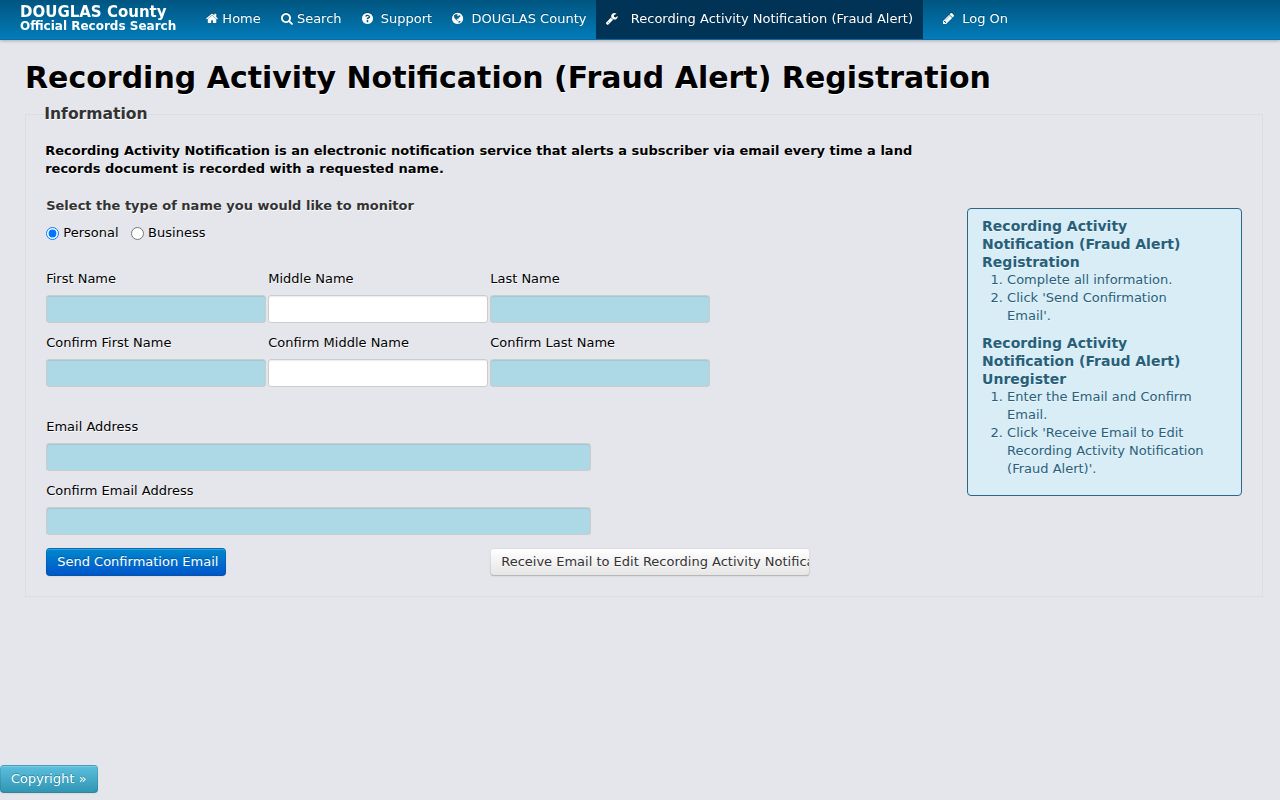
The form illustrates a useful safeguard for a name tied to an Omaha instrument: keep the notification separate from the underlying document search and verify an alert with the Register of Deeds record.
| LandmarkWeb field | Use in an Omaha search | Result boundary |
|---|---|---|
| Addition or Lands | Choose the property-description path | Not a current-address search |
| Deed or Mortgage | Choose the index type | Shows an instrument class |
| Addition name or S/T/R | Locate the index book | Retain legal wording as recorded |
| Book and page | Open or request the record image | Image access may be gated |
Omaha Current Resident Sources
The current Omaha sources below have different subjects. An Omaha assessor result concerns a parcel and can show an owner or mailing address. An Omaha recorded instrument names parties to a transaction. The county election tool concerns Omaha voting information at an address. A court result concerns an Omaha case party. Those distinctions make the Omaha residents directory more reliable than a blended name list.
| Omaha source | What it can show | Custodian | Access route |
|---|---|---|---|
| Omaha valuation and parcel record | Omaha parcel characteristics and owner fields as displayed | Douglas County Assessor | Official lookup or office help |
| Omaha recorded instrument index | Grantor, grantee, book, page, and document trail | Register of Deeds | LandmarkWeb, counter, or microfilm request |
| Voting-information lookup | Polling place, ballot, officials, and subdivisions for an address | Election Commission | House number and ZIP tool |
| Omaha case index | Omaha case party and procedural information | Nebraska Judicial Branch | eServices, terminal, or clerk request |
| Historic Omaha directory run | Dated Omaha publication listing and address clue | Omaha Public Library | Print, microfilm, or research request |
When the question is about one person rather than an address or a historical household, use the narrower verification sequence on the Omaha resident lookup page.
Omaha Election Address Limits
The Douglas County Election Commission offers an Omaha House Number and ZIP Code lookup. Its Omaha result can identify a polling place, candidates, sample ballot, elected officials, and political subdivisions for the address entered. It is not a name search and cannot prove that a particular person currently lives there. Nebraska VoterView is a statewide verification route, but protected records and update timing still matter.
Nebraska Revised Statute §32-330 permits inspection of registration records in the conditions it sets, while tightly controlling copying, use, and internet posting. The Secretary of State’s statewide voter-file process has an affidavit, a $500 fee, and purposes set by the office. That product is not a general Omaha residents directory shortcut.
The county’s address-based voting-information screen is shown below.
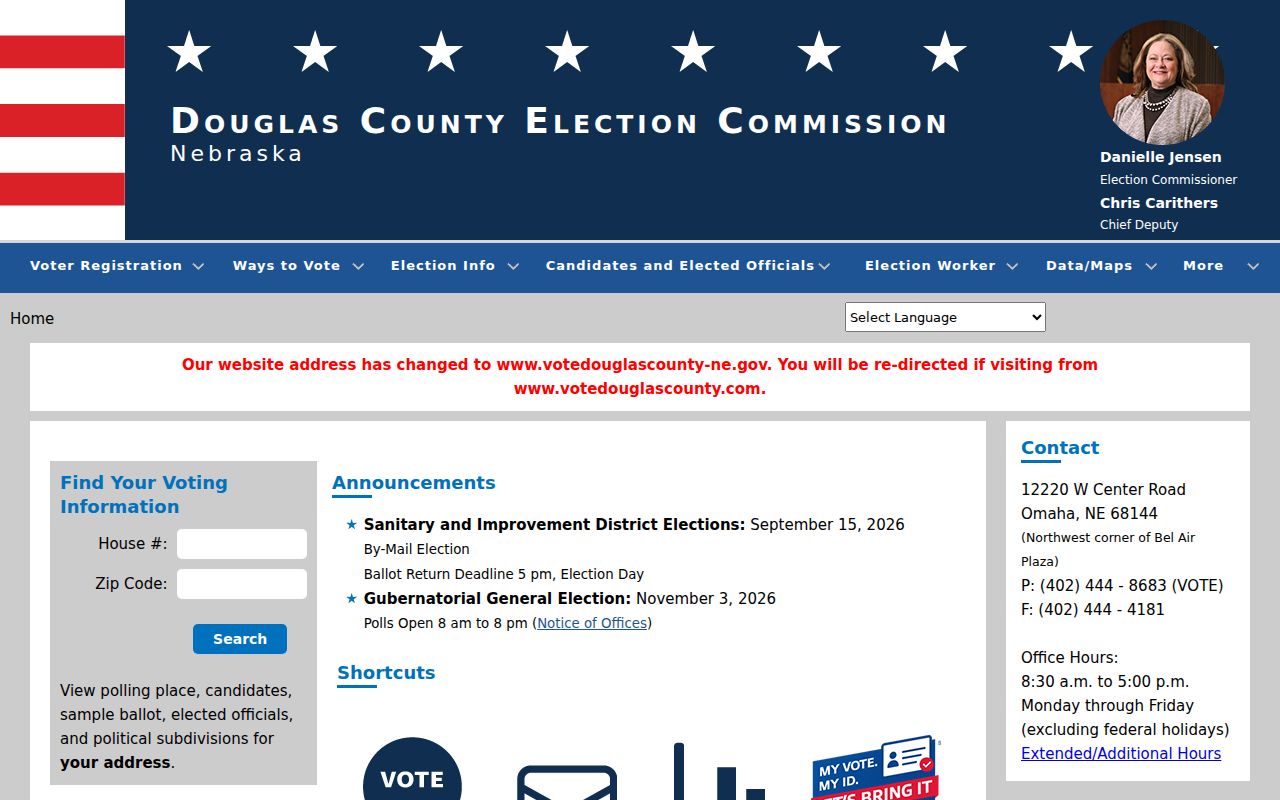
The screen’s house-number-and-ZIP design is the practical reminder that an election address result and a person-level residency claim are different things.
Omaha Directory Record Terms
Omaha sources reuse a few Omaha record terms, but they do not mean the same thing. Keeping them straight avoids bad matches when an Omaha address appears in an Omaha parcel view, a deed index, and an old city volume.
- Parcel
- A defined property unit used in assessment and map systems. It can change over time and is not a household roster.
- Index
- A finding tool that points to a record, such as a book and page, rather than the full record itself.
- Grantor and grantee
- The parties who transfer and receive a recorded interest. Their roles do not establish occupancy.
- Criss-cross directory
- An address-oriented directory arrangement that can supply a dated household lead when a volume provides it.
For an Omaha address that will not resolve in a modern portal, an old plat or map can bridge the street address to an addition, lot, block, or legal description. That legal description is often the better LandmarkWeb search key.
Omaha Court and Vital Checks
Nebraska Judicial Branch eServices covers Omaha county and district court cases within a statewide system. A free general subscriber search can be narrowed by party name, court type, case type, Douglas County, year, judge, and attorney. The one-time party-name search is currently $17, permits up to 30 results, and lasts three calendar days. Courthouse terminals and participating law libraries are free access channels. An Omaha case caption does not establish identity or wrongdoing, and sealed or juvenile material may be absent.
Nebraska DHHS Vital Records is different again. Certified birth, death, marriage, and divorce records have eligibility, relationship, purpose, and identification rules. The agency’s current instructions list $17 for a birth certificate and $16 for death, marriage, or divorce. For genealogy, DHHS requires documentation that the registrant has been dead at least 50 years. Older Omaha leads may be in county or library material, but that does not create certificate access.
The Judicial Branch case-information service supplies the official court-search starting point.
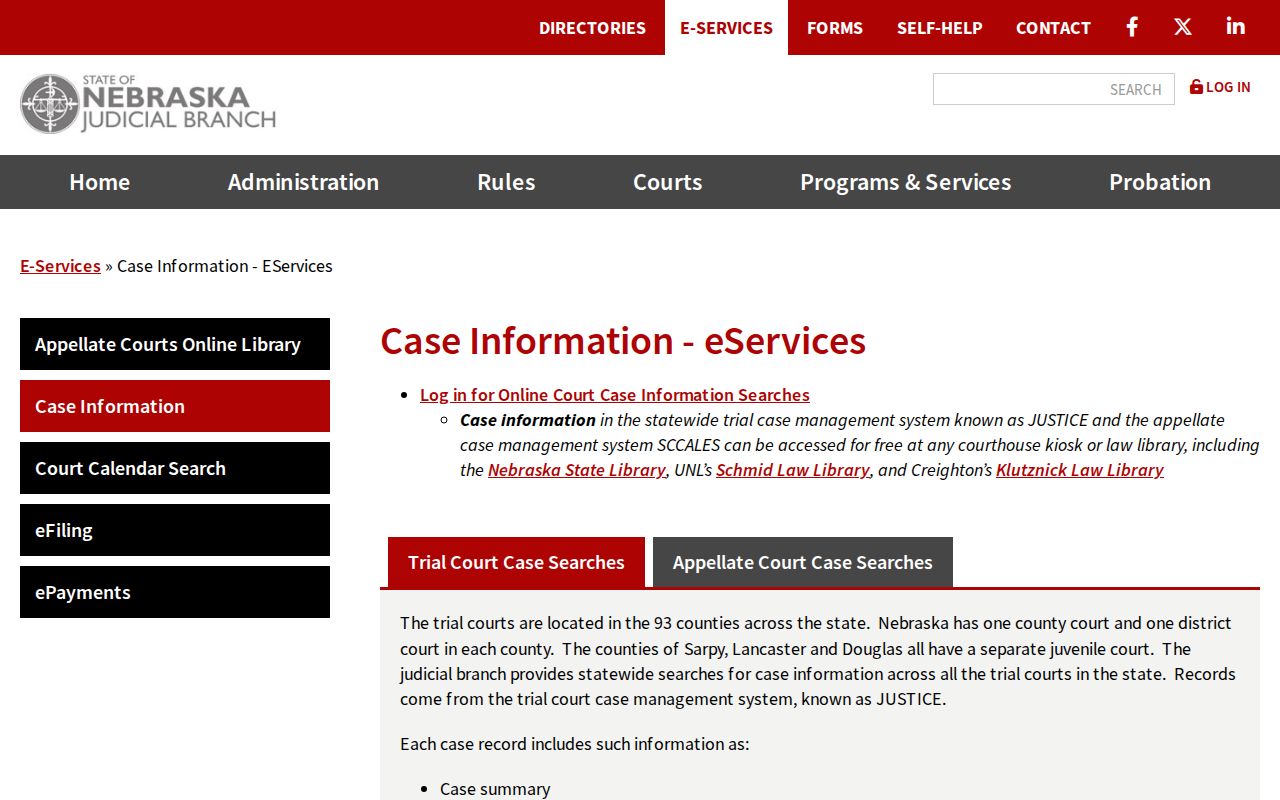
Use the court, county, year, and case-type filters to reduce same-name results before comparing any Omaha record.
DHHS vital-record instructions explain the state’s certificate routes.
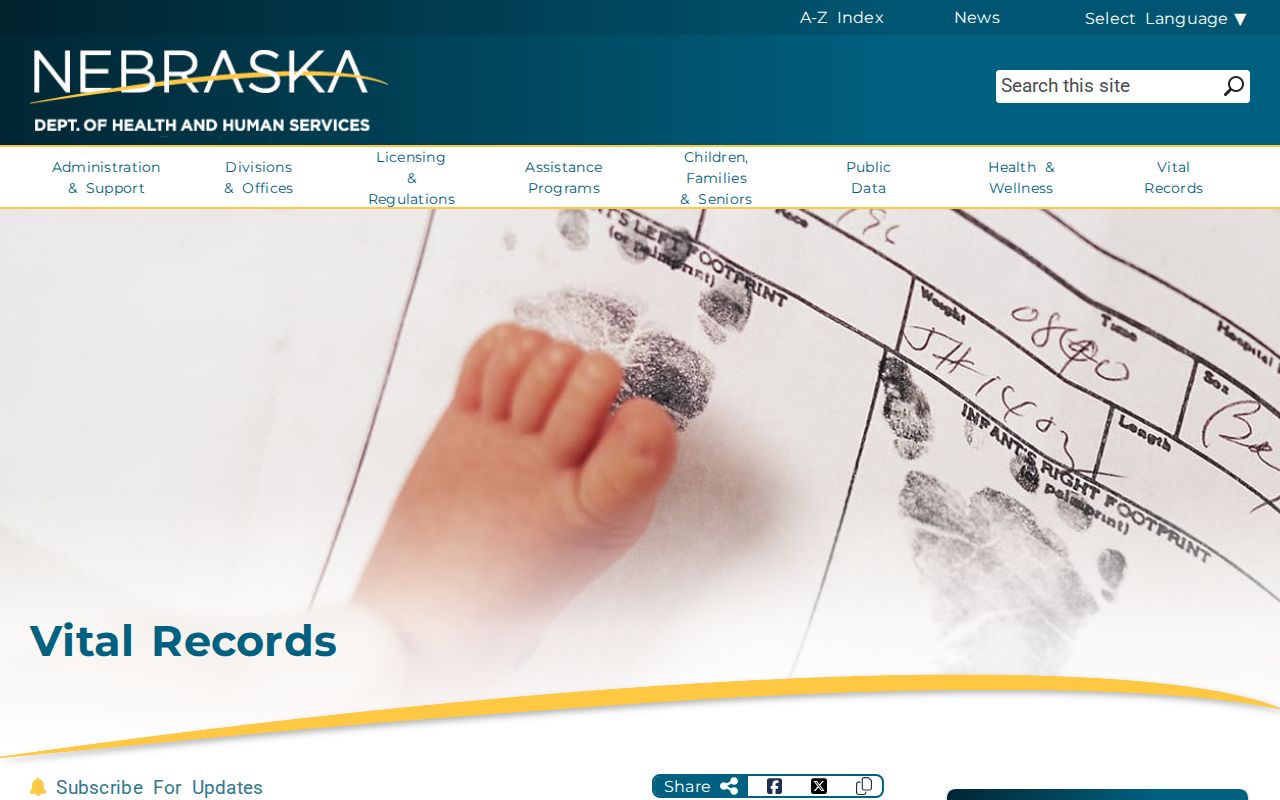
The eligibility and documentation steps shown by DHHS are part of the record search, not an optional afterthought.
Omaha Historical Directory Shelf
Omaha Public Library keeps Omaha print city directories from 1866 to the present, while its historical-microfilm information lists Omaha directories from 1866 through 1979. Another Omaha catalog description refers to microfilm through 2001, so confirm the exact volume and format with the Genealogy & Local History Room. The 1866 Collins volume is digitized, but the library’s collection is the stronger local path for a year-by-year Omaha search.
Directory entries can contain a name, initials, address, occupational or business context, and period abbreviations such as res, bds, and cor. They are dated publication clues, not proof of an unbroken Omaha residence. The historical collections and reading method are detailed in the Omaha Directory Book.
Note: Keep the publication year and the directory’s own city label, especially where an older volume uses South Omaha, Benson, or another local label.
Omaha Postal and Parcel Caution
An Omaha mailing address has more than one geography attached to it. A ZIP code is a Postal Service delivery tool, while a parcel identifies land and a city-limit layer identifies a municipality. The research working set includes common Omaha mailing ZIPs from the downtown core to West Omaha and the southern edge, but it is not a certified municipal-boundary table. Nearby ZIPs can carry an Omaha postal label while serving another municipality. For a current mailing answer, use the USPS ZIP Code Lookup; for the city and parcel context, compare the result with DOGIS and the county property record.
Older records need the same caution in reverse. A directory may print South Omaha, Benson, a township, an addition, or a rural-route description where a current form accepts Omaha. Preserve the source wording before normalizing it. Then keep the postal city, municipality, county, ZIP, parcel, addition, lot and block, and source date as separate notes. This simple geography check prevents a correct Omaha record from being tied to the wrong place or time.
Note: A postal label, neighborhood name, voting subdivision, and parcel can all describe one address without being interchangeable.
Omaha Archives Need Specific Requests
The Nebraska State Historical Society’s Douglas County finding aid, RG0230, spans 1855 to 2000 and describes about 1,780 reels, 72 boxes, 90 cubic feet, and 224 volumes. Its Omaha scale is a reason to ask for an Omaha collection, series, date range, volume, or reel instead of only a surname. It includes historical county material such as elections, marriages, courts, naturalization, probate, and indexes.
Omaha Public Library is a second archival channel. Its local-history resources include directories, newspapers, cemetery material, probate fee books, naturalization indexes, and local registers. The library’s research-help service will check city directories, obituary cards, and book indexes for up to three names or items. Standard copy work is $5 in advance; a more extensive request may be up to a half hour for $20 in advance, including five copies, with extra pages at $1.
These request routes make a useful Omaha residents directory fallback when a web interface has no image, a search form is blocked, or a record needs an institutional check.
Omaha Official Records Compared
Official Omaha systems show an Omaha source-specific fact and usually identify the custodian, date, record role, and request path. Commercial lookup listings may combine older entries from unclear dates. Use the first type to verify a defined Omaha record and treat the second only as a prompt to locate the actual office-held source.
| Question | Official Omaha route | What to preserve |
|---|---|---|
| Who owns this parcel? | Assessor and LandmarkWeb | Parcel, instrument role, date, and legal description |
| What voting information fits this address? | Election Commission lookup | House number, ZIP, and date checked |
| Was a person listed in an old year? | OPL city directory volume | Printed spelling, page, and publication year |
| What happened in a public case? | JUSTICE or clerk record | Case number, party role, and disposition |
Note: A direct record image, a library volume, or a clerk response has more weight than an undated copied listing.
Omaha Public Records Request Path
Nebraska Public Records Statutes, Neb. Rev. Stat. §§84-712 through 84-712.09, provide a route to existing non-exempt public records. The Nebraska Attorney General guidance says a written request should receive access or copies, a written denial, or a written delay explanation within four business days. A request should name the custodian, record type, date range, name or parcel, preferred format, and willingness to inspect. Agencies are not required to create a new resident list or an abstract they do not maintain.
The Attorney General’s public-records guidance is pictured here.
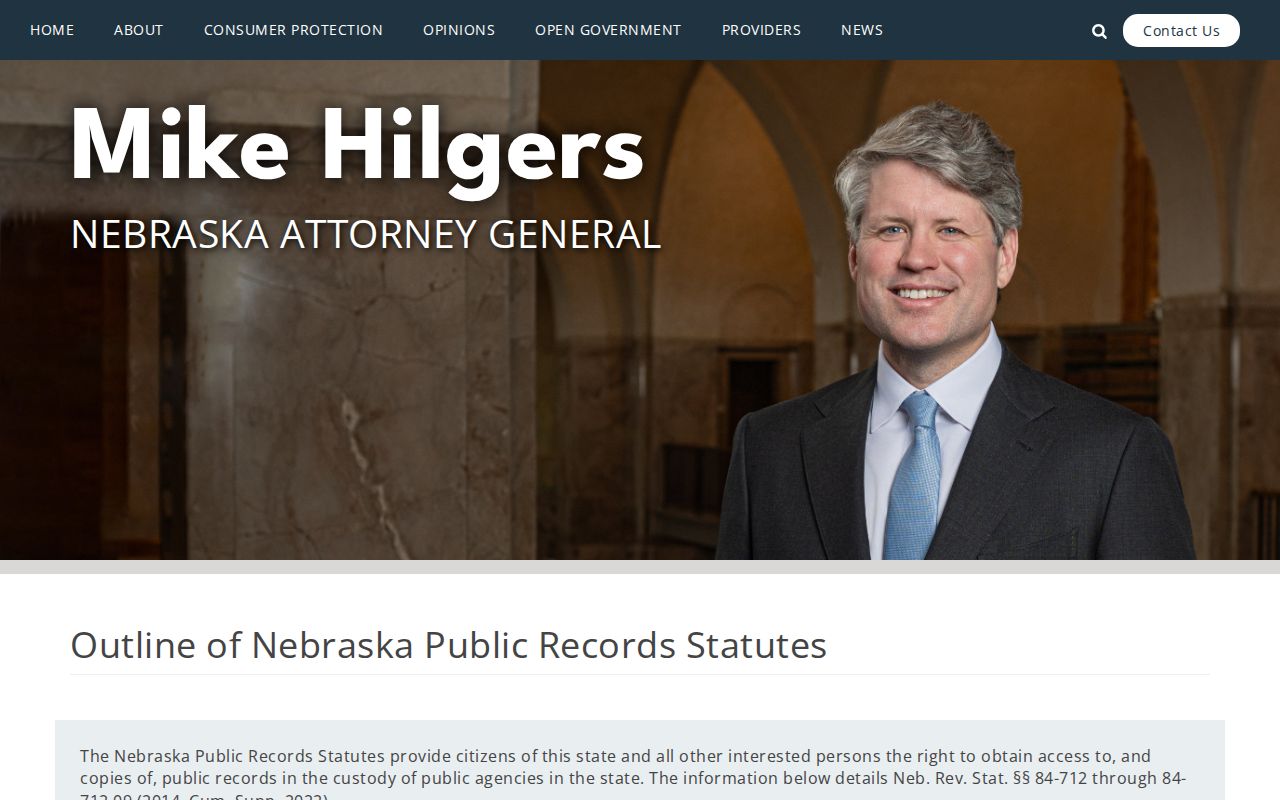
The guidance helps distinguish an inspection request for an existing Omaha record from a request for a newly created directory.
Omaha Protected Record Boundaries
Omaha research stops at the privacy rule that controls the source. Nebraska’s Address Confidentiality Program provides a substitute address and mail forwarding for qualifying participants facing safety risks. Vital records, protected election records, juvenile material, sealed court records, and motor-vehicle information also have their own restrictions. A blank result may reflect access controls or the search’s coverage rather than an absence of records.
Lawful personal research. Use Omaha record sources for family history, estate questions, civic context, or checking a source. Do not use them to stalk, harass, intimidate, or harm another person.
When a result appears inconsistent with a protected address, stop copying it and ask the custodian for the safe public version. That preserves both the Omaha record’s value and the person’s safety.
Omaha Results Need Dates
An Omaha directory listing, deed, permit, court index, cemetery card, or election record is strongest when it is described as the record it actually is. Save the source date, search date, person’s role, raw address, normalized address if one was used, access limit, and confidence level. Compare middle initials, family names, address history, and record dates before joining same-name entries.
That discipline matters in Omaha because postal city, municipal boundary, parcel, neighborhood, and historical label can all differ for one location. A dated, source-linked observation is more useful than a flat profile. It also leaves a clear next step: inspect the image, request the file, consult the library shelf, or verify the current geography in DOGIS.